
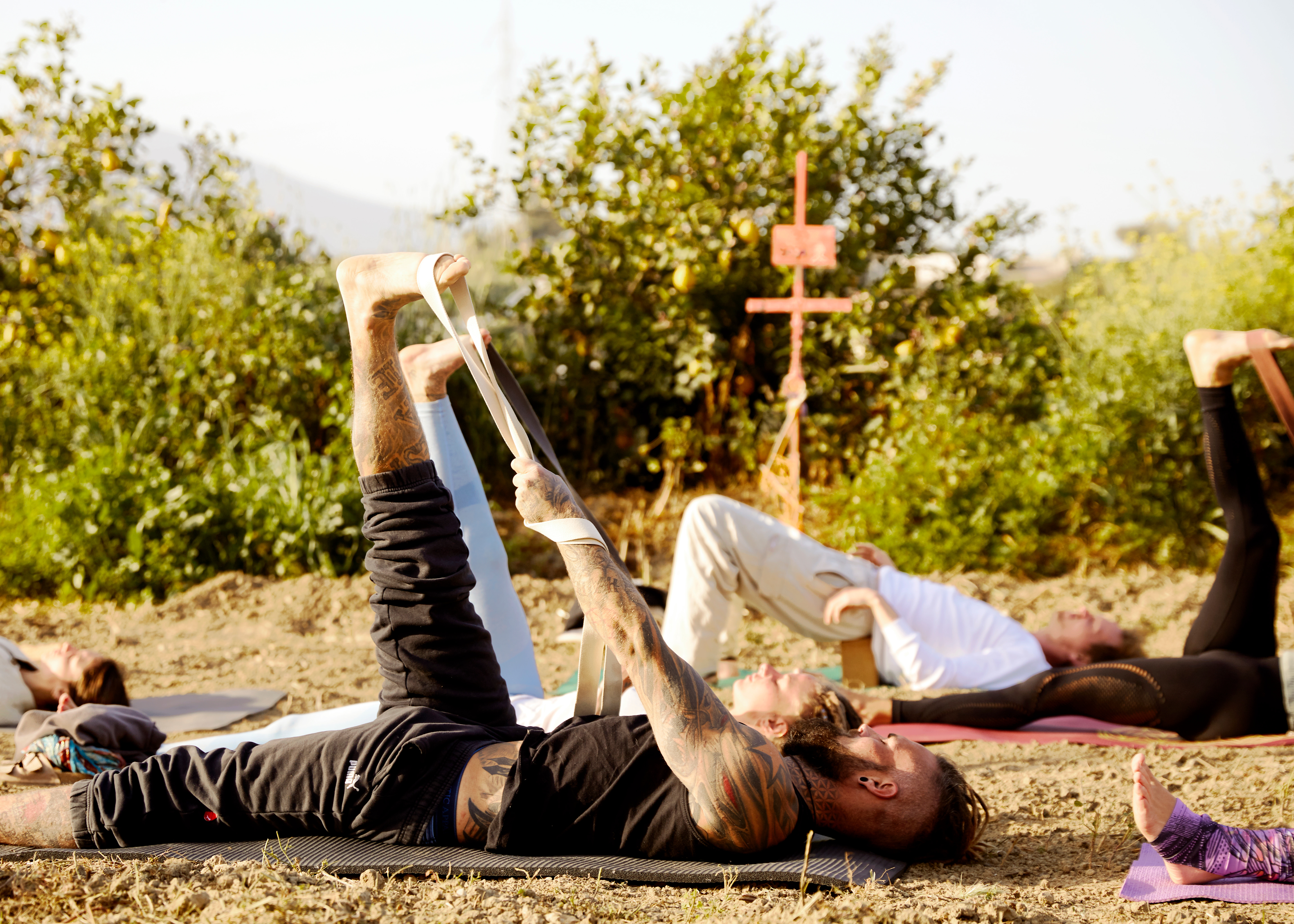
Yoga outdoors — a practice with the land
— TrustGaia
Most people meet yoga indoors first. A wooden floor, a mirror, a soft playlist, a teacher near the front. That is a good beginning. It is also, if you stay only there, a small part of what yoga can be.
At TrustGaia we practise on a wooden platform above the Mediterranean, on land that slopes gently down toward the sea. It is not a spectacular setting. There is no waterfall behind you, no drone in the sky. There is a breeze that changes through the day, a few olive trees, the sound of the coast below, and enough space to lay a mat down and breathe.
What we notice, again and again, is how much the outdoors asks of the practice — and how much it gives back.
**The first thing that changes is the breath.** Indoors, air is neutral. Outdoors, it has weight. In the morning it is cool and slightly damp from the sea. By mid-morning it warms and carries the scent of pine and dry earth. In the evening it softens again. When you follow your breath in that kind of air, you stop being an observer of your body and become part of a larger movement — the sea breeze rising up the slope, the leaves turning, your own chest rising and falling with it. That is not a metaphor. It is a physiological fact: your nervous system responds to that shared rhythm and quiets down.
**The second thing that changes is what the postures ask of you.** On a perfectly flat studio floor, alignment is easy to fake. On a wooden platform, with a slight give in the boards and a real horizon in front of you, small imbalances show up. A standing pose that felt steady indoors will wobble a little. You will feel the outside edge of one foot pressing harder than the other. You will notice that your gaze wants to drift toward the sea rather than to a fixed point on a wall.
This is not a problem. It is information. Outdoor practice tends to slow you down for exactly this reason — you cannot rush through the shapes without noticing what your body is actually doing. People who have practised for years often say, after a few days here, that they feel like beginners again. They mean it kindly. Beginners pay attention.
**The third thing that changes is what counts as a good session.** In a studio, a good class is often one where you sweat, where the sequence is challenging, where you leave feeling like you accomplished something. Outdoors, the standard shifts. A good session might be twenty minutes of very simple movement — cat and cow, a few gentle twists, a long child's pose, a slow standing sequence — followed by ten minutes of sitting quietly and watching the light change on the water. On paper, that is not an intense practice. In experience, it can be one of the more restorative hours of your week.
We do not teach a single style at TrustGaia. Sessions here draw from hatha, from slow vinyasa, from restorative work, from simple breath practices. What links them is pace and honesty. We do not push you into shapes that do not belong to your body. We do not promise that yoga will fix anything. We offer a structure — a mat, a platform, a teacher, a rhythm — and let the practice do what it does.
**A few practical notes** if you are thinking about practising outdoors, here or elsewhere:
Wear layers. The temperature will shift more than you expect, especially in the morning and evening. A light long-sleeve is often welcome for the opening minutes and the final rest.
Bring a real mat, not a towel. A grippy mat is what lets you move slowly and confidently on an uneven surface. Borrowed studio mats are usually softer and thinner than what works well outside; a slightly firmer travel or all-terrain mat is worth the small investment.
Eat lightly beforehand. Twist and inversion feel very different on a full stomach outdoors, where you are already responding to more sensory input than you would inside.
Expect the first ten minutes to feel a little scattered. There is more to notice — light, wind, sound — and your attention will move. This is normal. Come back to the breath, and then to the shape, and then to the breath again. That coming-back is the practice.
Allow silence at the end. The strong temptation, in a beautiful outdoor setting, is to fill the final rest with commentary — 'wow, that view, how lucky are we, this is so peaceful.' The commentary is understandable. It also breaks the very state the practice just built. If you can, lie down quietly for a few minutes and let the setting land in you without narrating it.
**A quiet closing note.** Yoga outdoors is not better than yoga indoors. It is different. A good studio in your city, walked to on a regular schedule, will do more for your body over a year than one weekend of practising above the sea. What outdoor practice can do — what a retreat can do — is remind you what the practice is for. Not to master shapes. Not to look a certain way. To come back into your body, in the place where your body actually is, and to notice, without commentary, that you are here.
That is what we try to hold space for. A mat, a breath, a horizon, and enough quiet to let the practice do its work.